“If I’m alive, how can I make it intentional?”
A feature on Boricua multimedia artist Jo Cosme by Charlie Brewer
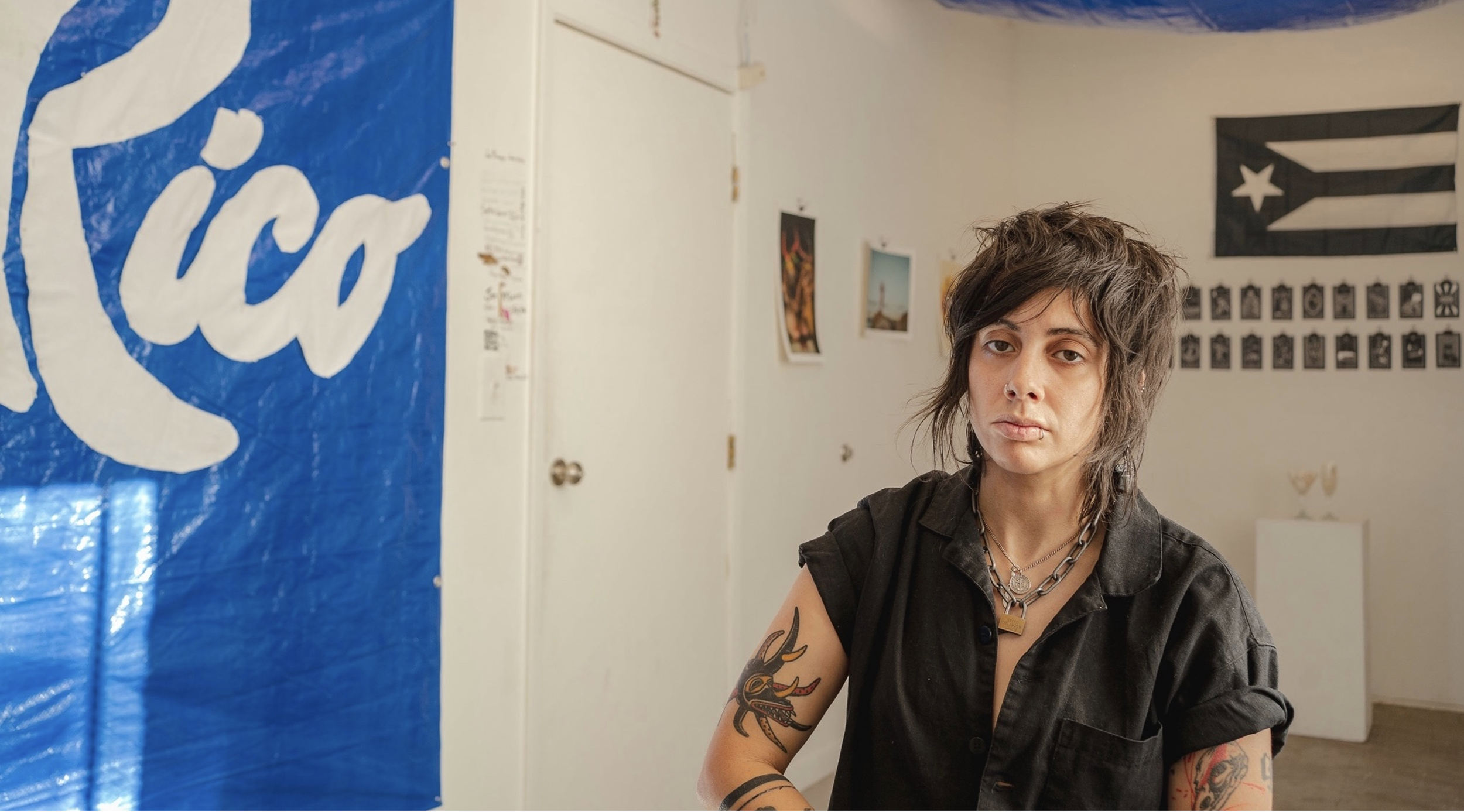
A self-portrait of Jo Cosme among her work, unflinching at the camera. (Cosme, 2020).
You would know Jo Cosme was an artist just by looking at her. If the thick glasses, all black clothing, and hand tattoos didn’t give it away, the reserved demeanor and blink-and-you’ll-miss-them quips certainly would. On our Zoom call, Jo’s black ball cap embroidered with a battery at 1% tells me everything I need to know about her energy level.
I first met Jo at the opening of TIERRA FUTURA: Boricua Land Futuresat WaterFire Arts Center in Providence. The exhibit featured artist Shey Rivera Ríos, who brought together Boricua artists to celebrate their culture through multimedia art.
Jo was leaning back in a folding chair for the Q&A, listening and nodding as the other artists in the exhibit chatted and laughed. She offered a comment here and there (in Spanish, so I wasn’t in on the joke, but her comments made everyone else laugh. I liked her immediately). The Q&A wrapped up, and the artists mingled with the audience to view each other’s work.
As I wandered, I kept passing by Jo and losing my nerve to approach her. Despite my cowardice, my eyes were continuously drawn to her photographs: an image of two naked women locked in a time-lapse embrace inside an open refrigerator. Another image of a bare woman, staring out a window into a lush green forest. There was something about her work that moved me, something I couldn’t place.
When I finally gathered the courage to approach Jo, she could not have been friendlier.
We had a short but profound conversation about how her Boricua heritage interacts with her queerness to create pieces unique to her, and how our mutual queerness manifests itself in our artwork.
Now, as we reconnect in June, Jo’s pride in her identities shines through. A Puerto Rican flag hangs on the wall in her apartment, a straw pava hat below it, a colorful banner boldly proclaiming “DYKE” next to that.
Despite her exhaustion, she is primed to discuss her work. This time, we’re able to dive into the past, present, and future of what makes Jo the artist she is.
She studied for her BFA in photography from the Escuela de Artes Plásticas y Diseño (School of Fine Arts) in Puerto Rico. After she graduated, “art became too hard,” so she became a photojournalist.
In September 2017, Hurricane Maria devastated the northeastern Caribbean. Jo found herself without electricity for six months, helping her community get food and water, and forming brigades for mutual aid. “See?” she says wryly. “Socialism can work.”
The United States and local governments’ response was less than satisfactory. A roll of paper towels became a symbol of resistance when President Trump tossed one into a crowd of survivors, while they remained without food, power, and fuel for months.
“If I were a poet,” Jo tells me, “I would write a poem. A love letter to my rage. Rage was a thing that poisoned me for many, many years. And then I realized that rage could be equally powerful if I turned it into, instead of a destructive force, a creative one.”
And so she did. Fueled by her rage at the government’s utter apathy, Jo created a deck of tarot cards (on an ever-dying laptop, with a flashlight in her mouth) that represented the individual stories that became metaphors for the larger catastrophe. The deck was featured in the Museo de las Americas’ Catarsis exhibit, then picked up by Hyperallergic magazine.
In the Hyperallergic feature, Jo said, “It felt like a well-orchestrated humanitarian crisis — Hurricane Maria being the one to blow away the carpet that covered all the lies, corruption, and deceit, leaving everything a lot more exposed than before. We’ve all felt like we’ve been living in a never-ending purgatory here in Puerto Rico.”
That feature funded her move out of Puerto Rico to Seattle. From there, she applied to residencies and artist grants, and her career took off. As she settled in, the disparities between what she knew of her homeland and the way mainland Americans understood what it meant to be from Puerto Rico became clear: “There’s a big, big, big disconnection between the lived Puerto Rico versus the idealized vacation resort Puerto Rico, and also the colony of Puerto Rico versus,” [here, she adopts a nasally American accent] “aren’t you a territory, Puerto Rico?”
This disconnect came to a head when she came across a Discover Puerto Rico tourism campaign. Her homeland had been reduced to a product, despite the fact that she and her community had been abandoned to rebuild entirely on their own. She decided it was time to force the North American people to question their colonizer language around the construction of paradise: “How do I bring [them] to discover what, as a native people, a native perspective, what it is to discover Puerto Rico? … What does that mean, to vacation in a colonized land?”
She created Welcome to Paradise: ¡Viva Puerto Rico Libre!, a multimedia exhibit designed to challenge the Discover Puerto Rico tourism by injecting Boricua realities like cultural identities and effects of the hurricane. Jo’s rage-turned-cynical-humor is all over the exhibit: A VIP lanyard hangs near the entrance. Upon a closer look, it says, “All you can extract pass.” A hurricane tarp with “Discover Puerto Rico” printed on it, over which a light flashes, “GRINGO GO HOME.” Red signs proclaim, “Puerto Rico no se vende”(Puerto Rico is not for sale).
Despite all that’s happened, Jo considers herself one of the lucky ones. She has stable housing. Transportation. Healthcare. She is inspired by those back home still recovering from the hurricane, and those around the globe facing war and genocide, like Palestinians, Congolese, Jamaicans, and more.
“Those of us who have the privilege to not be bombed actively right now, those of us who have the stamina and courage and energy to speak up, then we absolutely should,” she says. “Because they’re relying on us.”
